What Is Print on Demand & How to Start a POD Business
September 12,2026 2:00 AM(UTC+8) 310 views
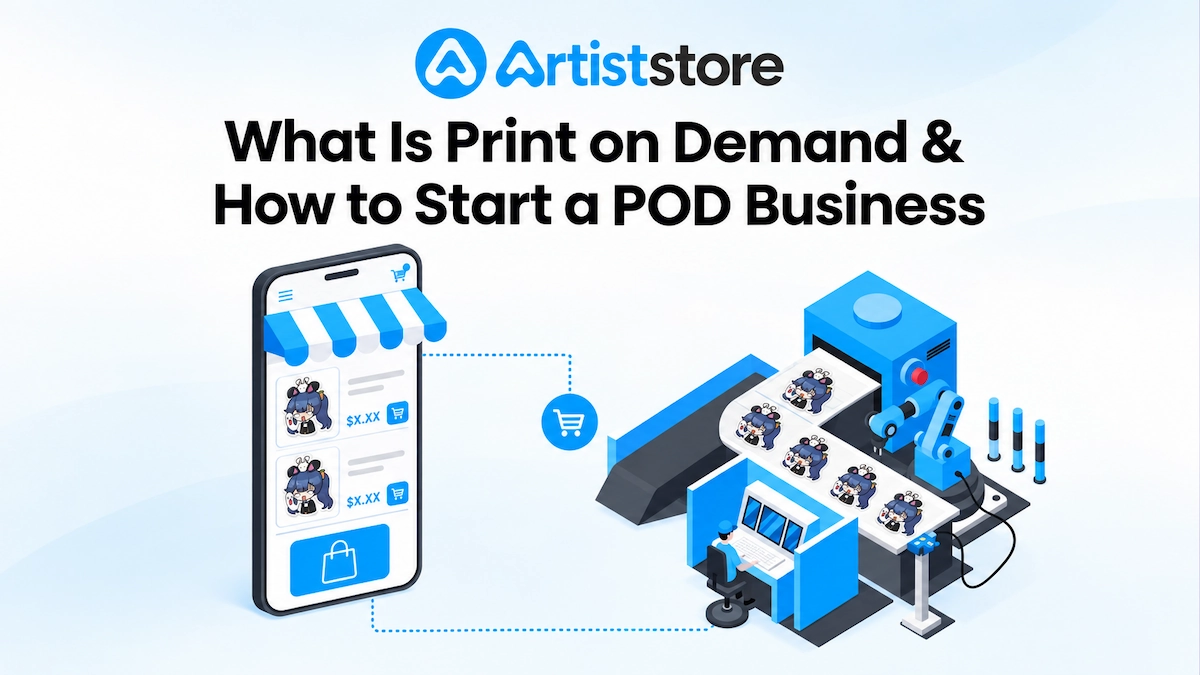
Print on demand has made it possible to launch products without filling a spare room with inventory or paying for a large production run before the first sale. For artists, designers, creators, and small brands, that can turn a single idea into a sellable product with far less inventory risk.
But POD is not an automatic-income shortcut. You still need a clear audience, products people want, original designs, sensible pricing, reliable fulfillment, and a reason for customers to choose your store over countless alternatives.
This guide explains what print on demand is, how the model works, what it costs, and how to build a POD business from your first niche idea to a live store.
What Is Print on Demand?
Print on demand (POD) is an ecommerce fulfillment model in which a product is made only after a customer places an order.
Instead of buying finished inventory in bulk, you create or upload a design, place it on an eligible product, and list that product for sale. When an order comes in, a POD provider produces the item, packs it, and ships it to the customer.
The model is commonly used for apparel, art prints, stationery, accessories, home and living products, and creator merchandise. The exact catalog depends on the provider you choose.
How Is Print on Demand Different From Traditional Inventory?
The biggest difference is when production happens. Traditional retail usually requires you to buy or manufacture inventory before you know exactly what will sell. POD moves that production decision until after the sale.
| Factor | Print on Demand | Traditional Inventory |
| Inventory | Made after an order is placed | Purchased or produced in advance |
| Upfront stock cost | Low or none for inventory | Usually higher |
| Unsold-stock risk | Low | Higher |
| Cost per unit | Often higher than bulk production | Can fall with larger quantities |
| Fulfillment | Usually handled by the POD provider | Handled by you, a warehouse, or a 3PL |
| Control | Less control over production and shipping details | More control when you manage stock directly |
Neither model is automatically better. POD is useful for testing ideas and reducing inventory risk, while bulk production can become more attractive when demand is proven and lower unit costs matter more.
How Does Print on Demand Work?
Most POD businesses follow the same basic flow:
1. You create an original design or artwork.
2. You choose a product and prepare the design for that product’s print or production specifications.
3. You publish the product in your online store or sales channel.
4. A customer places and pays for an order.
5. The order is sent to your POD provider for production, packing, and shipping.
6. You keep the amount left after product costs, fulfillment expenses, payment fees, marketing costs, taxes, refunds, and any other business expenses.
From Design to Customer Delivery
A good POD workflow should feel simple to the customer even though several systems are working behind the scenes. Your storefront handles the shopping experience. Your payment setup processes the sale. Your POD partner handles production and fulfillment.
With an integrated workflow, orders can move to production automatically. With a manual setup, you may need to submit or approve orders yourself. Either way, you remain responsible for the customer experience: clear product information, realistic shipping expectations, responsive support, and a brand people trust.
Pros and Cons of Print on Demand
POD lowers some of the barriers to selling custom products, but it also trades inventory risk for less control over unit economics and fulfillment.
Benefits of Print on Demand
· No bulk inventory: You can list products without committing to a large production run.
· Lower inventory risk: A design that does not sell does not leave you with boxes of unsold stock.
· Faster product testing: New designs, characters, themes, and product ideas can be tested with a smaller commitment.
· Outsourced fulfillment: Production, packing, and shipping are usually handled by the provider.
· Flexible catalog: You can add products or retire weak performers without clearing physical stock first.
· Accessible for creators: Artists can spend more time on design, audience building, and marketing instead of warehouse operations.
Challenges to Consider Before You Start
· Higher per-unit costs: On-demand production is often more expensive per item than a proven design produced in bulk.
· Less fulfillment control: Production times, carrier performance, and packaging options depend partly on your provider.
· Variable margins: Shipping, payment processing, advertising, refunds, and taxes can quickly reduce a margin that looks healthy at first.
· Quality depends on the partner: Print accuracy, materials, color, finishing, and consistency vary by provider and product.
· Crowded markets: Low barriers to entry also mean many sellers compete for attention.
· Customer expectations remain yours: Even when a third party fulfills the order, customers still see you as the seller.
What Can You Sell With Print on Demand?
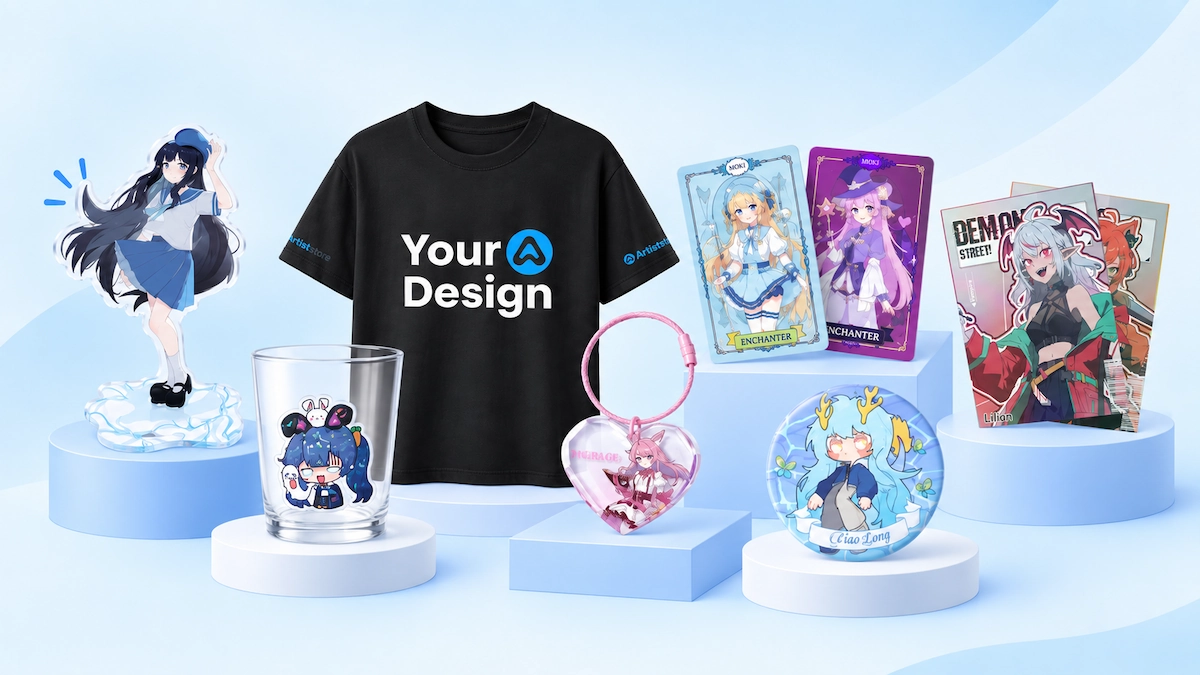
POD is no longer limited to basic logo T-shirts. Depending on the provider, you can build a store around wearable products, collectibles, art, desk accessories, home goods, or a mix of categories.
Popular POD Products for Artists and Creators
· Apparel: T-shirts, hoodies, sweatshirts, hats, socks, and other wearable products.
· Art and paper goods: Posters, art prints, postcards, notebooks, and selected stationery.
· Creator merchandise: Stickers, pins, keychains, standees, charms, and other small collectibles when supported by the provider.
· Accessories: Tote bags, phone cases, pouches, wallets, and similar everyday items.
· Home and living: Mugs, pillows, blankets, wall décor, and other customizable home products.
The best first product is not necessarily the product with the biggest market. It is the one that fits your artwork, audience, price range, and brand. A character artist may get more value from small collectible merch than from launching ten unrelated apparel items.
How to Start a Print-on-Demand Business
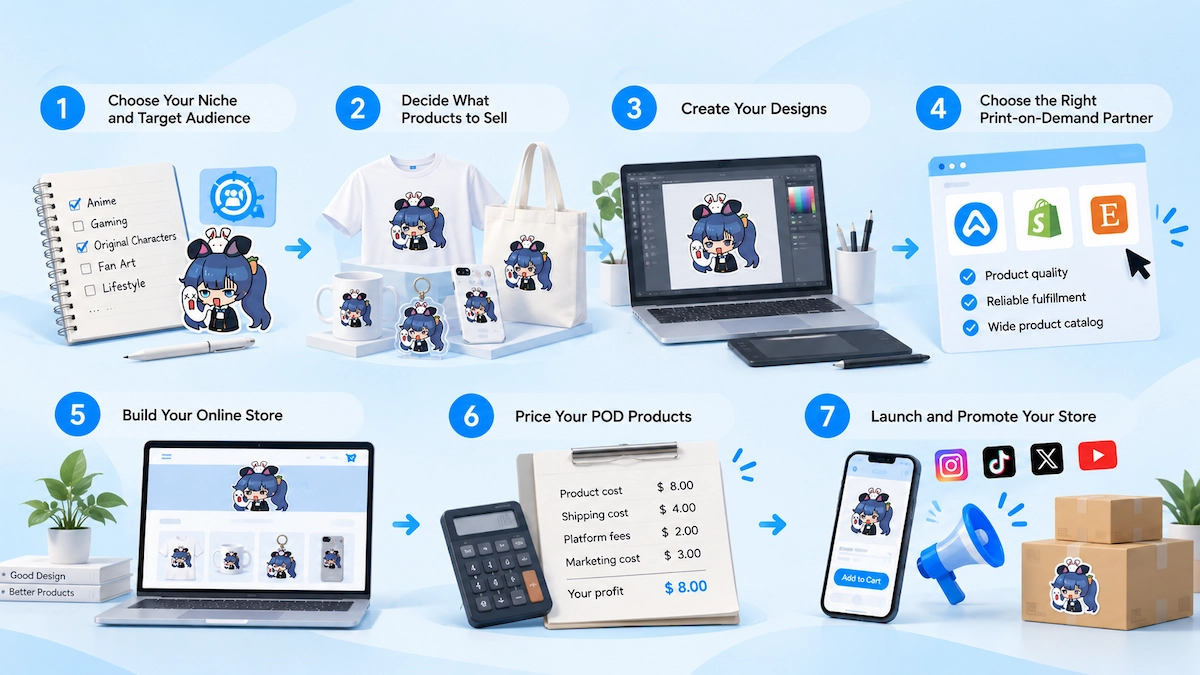
A POD store is easier to launch when each decision supports the same audience. Start focused, validate what works, and expand after you have evidence.
1. Choose Your Niche and Target Audience
“Everyone” is not a useful target market. Pick a group with a recognizable interest, identity, aesthetic, hobby, fandom, profession, or problem that your designs can speak to.
You can start from your own creative style, an audience you already have, or a community you understand well. Then check whether people actively buy products in that space. Search results, marketplace listings, social communities, creator stores, and keyword tools can all help you see what is already selling and where there may be room to stand out.
A good niche should be specific enough to shape your products and messaging, but not so narrow that you run out of ideas after the first collection.
2. Decide What Products to Sell
Do not launch with a giant catalog just because your POD provider offers one. Start with a small set of products that make sense together.
For example, an illustrator could build a first collection around one character using a sticker, keychain, print, pin, and standee. A typography brand might start with shirts, totes, posters, and mugs.
Before committing to a category, compare product cost, available sizes or variants, print area, shipping profile, and how naturally your design fits the item. Ordering samples of your most important products is one of the best ways to catch quality or layout issues before customers do.
3. Create Your Designs
Strong POD design starts with originality and production awareness. Use artwork you created yourself or have the legal right to use. Avoid copyrighted characters, logos, trademarks, and other protected material unless you have permission.
Prepare files to the specifications of the product and provider. Pay attention to dimensions, resolution, color mode, bleed or safe areas, transparent backgrounds, and placement. A design that looks good on screen can still print poorly if the file is too small or positioned badly.
You do not need hundreds of designs. A small set with a consistent visual direction is easier to present as a brand and easier to test.
4. Choose the Right Print-on-Demand Partner
Your POD partner becomes part of your customer experience, so compare more than the base product price.
· Product range and customization options
· Print or manufacturing quality
· Production times and consistency
· Shipping destinations, costs, and delivery estimates
· Branding and packaging options
· Sample ordering
· Store integrations or built-in storefront tools
· Return, replacement, and damaged-order policies
· Customer support and issue resolution
The cheapest provider is not always the best choice. A slightly higher fulfillment cost may be worthwhile if product quality, reliability, or shipping performance is noticeably better for your audience.
5. Build Your Online Store
You need a place where customers can understand the product, trust the brand, and complete a purchase. That can be your own online store, a marketplace, or a platform that combines storefront and POD fulfillment.
Keep the first version simple. Use clear product titles, strong mockups or photos, concise descriptions, transparent shipping information, and easy navigation. Organize related products into collections instead of making visitors search through an unstructured catalog.
Your homepage should quickly answer three questions: What do you sell? What makes the work recognizable? Where should a new visitor start?
6. Price Your POD Products
Pricing should cover more than the product’s fulfillment cost. Build from your real costs, then check whether the final price still makes sense for your market and brand.
Simple pricing check: Selling price − product/fulfillment cost − payment fees − marketing cost − expected refunds/discounts − applicable taxes and operating costs = estimated profit.
Not every cost applies to every order, but ignoring them can make a product look profitable when it is not. Leave enough room for occasional promotions and customer-service issues rather than pricing at the thinnest possible margin.
7. Launch and Promote Your Store
A store launch is the beginning of marketing, not the end of the project. Start with the channels where your audience already spends time.
· Post the creative process, not only finished product images.
· Show samples, close-ups, packaging, and real-life scale when possible.
· Build an email list so you are not dependent on one social platform.
· Create useful search-friendly content around your niche and products.
· Use limited launches or themed collections when they fit your audience.
· Track which designs, products, and traffic sources actually lead to sales.
For artists, behind-the-scenes content is especially useful because the story of how a design becomes a product can be as interesting as the product itself.
How Much Does It Cost to Start a POD Business?
POD removes the need to buy inventory in bulk, but “no inventory” does not mean “no business costs.” Your startup budget depends on the tools, platform, products, and marketing approach you choose.
| Cost Area | Typical Status | What to Consider |
| Inventory | Usually not required upfront | Products are generally made after orders are placed. |
| Store/platform | Free to paid | Some platforms charge subscriptions, listing fees, or service fees. |
| Domain | Optional but useful | A custom domain can strengthen branding and trust. |
| Design tools | Free to paid | Depends on whether you already create your own artwork or use paid software. |
| Samples | Recommended | Useful for checking quality, color, size, and packaging. |
| Marketing | Flexible | Organic content can reduce cash spend; ads require a test budget. |
| Payment processing | Usually per transaction | Rates depend on the processor and country. |
| Taxes/licenses | Varies | Requirements depend on your location and business structure. |
A sensible beginner approach is to keep fixed costs low, spend first on the things customers can actually notice—such as product quality and presentation—and scale marketing only after you know which products convert.
Is Print on Demand Profitable?
Yes, print on demand can be profitable, but the model does not guarantee profit. Results depend on your pricing, product mix, audience, conversion rate, repeat purchases, fulfillment costs, and how much you spend to acquire customers.
POD often has a higher unit cost than bulk manufacturing, so differentiation matters. Original art, a recognizable niche, good product selection, and an audience that cares about the creator or brand can support healthier pricing than competing only on price.
What Determines Your POD Profit Margin?
· Base product and production cost: Higher fulfillment costs leave less room unless the retail price also rises.
· Shipping strategy: Free shipping is not actually free; the cost still needs to be absorbed somewhere.
· Payment and marketplace fees: Small percentages matter when margins are thin.
· Average order value: Bundles and complementary products can improve the economics of each customer order.
· Marketing efficiency: A product can sell well and still lose money if customer acquisition costs are too high.
· Returns and replacements: Damaged, incorrect, or unwanted items should be included in your planning.
· Brand strength: A distinctive brand can compete on value instead of constantly discounting.
Track profit by product, not only total revenue. A bestseller with a weak margin may contribute less to the business than a lower-volume product with better economics.
Common Print-on-Demand Mistakes to Avoid
· Launching too many products: A focused first collection is easier to market and easier to learn from.
· Skipping samples: Mockups cannot tell you everything about material, print quality, color, or actual scale.
· Choosing a provider only by price: Cheap fulfillment can become expensive if quality problems create refunds and support work.
· Copying trends without a point of view: Trends can bring attention, but a store needs a recognizable reason to exist beyond the latest meme.
· Using artwork you do not have rights to: Copyright and trademark problems can lead to takedowns, lost revenue, or legal disputes.
· Pricing from the base cost alone: Payment fees, promotions, marketing, refunds, and taxes also affect profit.
· Hiding shipping expectations: Clear production and delivery information reduces frustration and support requests.
· Relying on one traffic source: A business built entirely on one social algorithm or one paid-ad campaign is fragile.
How to Start Print on Demand With Artiststore
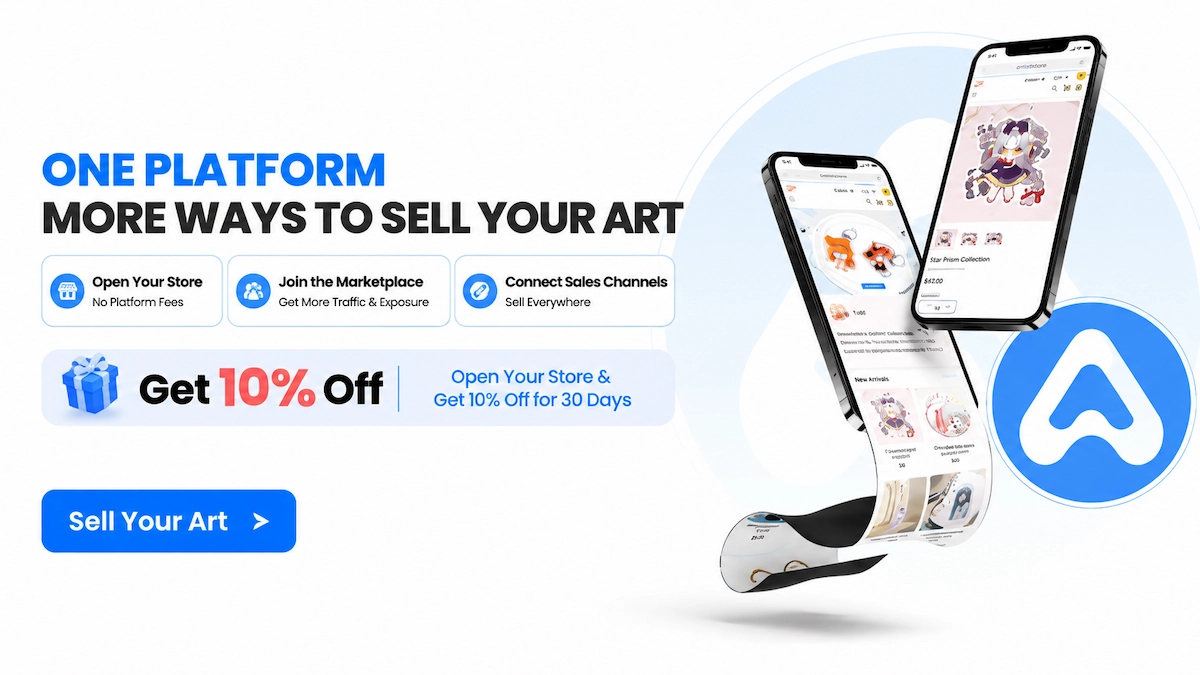
For artists who want the storefront and fulfillment side in one workflow, Artiststore is a print-on-demand and store-setup platform built specifically for artists and creators.
Its current model lets creators open a store and list products without monthly, annual, or platform service fees. Products are made on demand, so production costs are charged after a customer order rather than requiring bulk inventory upfront. Artiststore also offers more than 10,000 customization variants across categories such as keychains, stickers, pins, standees, prints, home and living products, and apparel and accessories.
The basic workflow is straightforward:
1. Apply for and set up your store.
2. Choose products and upload your artwork using the online editor and mockup tools.
3. Set your retail prices and organize your storefront.
4. Connect your payment and billing methods.
5. Publish and promote your products.
6. When an order is placed, Artiststore handles production, packaging, shipping, and after-sales support.
Customer payments can be received through a connected Stripe or PayPal business account, while product production and shipping charges are billed through the payment method connected for platform billing. For creators, the practical advantage is simple: you can test merchandise and build a branded shop without buying a large batch of stock first.
FAQ About Print on Demand
Do You Need Inventory for Print on Demand?
No. In the standard POD model, products are made after customers order, so you do not need to purchase and store finished inventory in advance. You may still want samples for quality checks and content creation.
Can You Start Print on Demand With No Money?
You can start without buying inventory upfront, and some store or POD platforms have free entry options. However, a real business may still have costs such as samples, a domain, design tools, payment processing, marketing, taxes, or required registrations.
Do You Need a Business License for Print on Demand?
There is no single worldwide POD license. Requirements depend on where you operate, your business structure, what you sell, and local tax or licensing rules. Check the official national, state/provincial, and local requirements that apply to your business.
What Are the Best Products for Print on Demand?
There is no universal best product. Strong choices fit your audience and artwork, have reliable fulfillment, leave enough margin, and are easy to present clearly online. Apparel, art prints, stickers, accessories, and creator merchandise are common starting categories.
Is Print on Demand Worth It in 2026?
It can be, especially for testing ideas, selling niche products, or launching creator merch without bulk inventory. It is less attractive when you need the lowest possible unit cost or complete control over production and shipping.
Can Artists Make Money With Print on Demand?
Yes. Artists can use POD to turn existing artwork into physical products and sell directly to an audience. Profit depends on demand, pricing, product quality, marketing, and repeat customers—not simply on uploading more designs.
The simplest way to begin is to treat POD as a testing system, not a shortcut: start with a clear audience, a small product range, original work, and numbers you understand. Then use real customer response to decide what deserves the next design, the next product, or eventually a larger production run.