How to Name Your Art Merch Products So Fans Can Find Them
October 28,2026 9:29 PM(UTC+8) 44 views
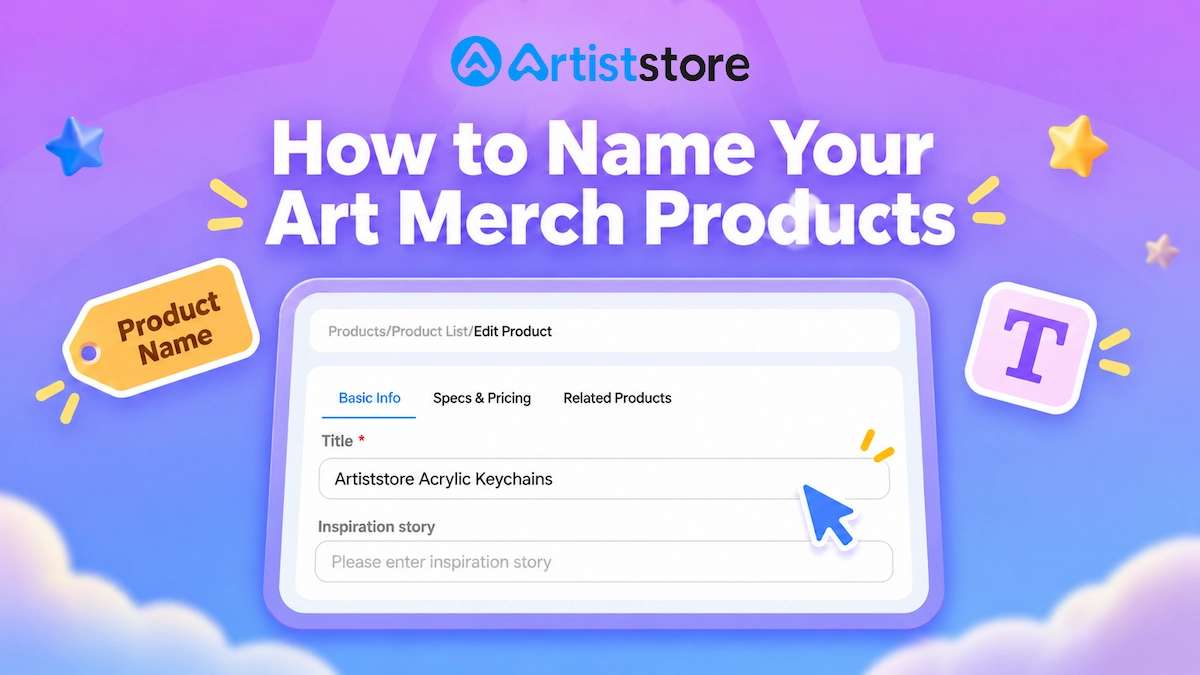
You've finished your artwork and turned it into a keychain, sticker, or print. Now comes a smaller decision that can make a real difference: what should you call it?
Many Artiststore creators start with the default product name and add a character or design name in front. It gets the listing published, but the result can be long, technical, or hard to distinguish from the next design.
A useful title helps fans recognize your work, new shoppers understand the product, and people find the right design. The recommendations below are flexible starting points, not naming requirements.
1. Start with the name buyers are most likely to recognize
Artiststore ’s preferred starting point is to lead with the most recognizable series, design theme, or IP/franchise, followed by the character (when relevant) and the actual product type. A character-first title is also a strong choice when fans know the character best. For original art, lead with the artwork title, theme, or OC that best identifies the design.
|
Recommended structure |
Example |
Best used when |
|---|---|---|
|
[Series/Theme/IP] [Character] [Product] |
Starfall Story Miko Acrylic Keychain |
Artiststore’s preferred default when the wider series or theme is recognizable |
|
[Character] [Series/Theme/IP] [Product] |
Miko Starfall Story Acrylic Keychain |
Also recommended when the character is the name fans recognize first |
|
[Series/Theme/IP] [Character] [Detail] [Product] |
Starfall Story Miko Holographic Keychain |
A finish or design detail identifies a particular version |
|
[Series/Theme/IP] [Character] [Product] [Version] |
Starfall Story Miko Acrylic Keychain #2 |
Numbered or collectible designs |
|
[Theme/Artwork/OC] [Product] |
Moonlit Garden Art Print |
Original artwork without a separate named character |
In [Series/Theme/IP], choose the ONE label that fits—series, theme, or IP—not all three. [Character] is optional. “IP” refers to intellectual property, such as a game, show, or franchise. “Starfall Story,” “Miko,” and “Pippa” are fictional teaching examples; use the real names of your work.
Both leading orders can work. Artiststore prefers the broader series/theme/IP first when it is an established search cue, but starting with the character is perfectly acceptable when that is how fans identify the work. A short title is often best for a single design; add detail only when it helps people recognize the right version.
2. Six practical habits for better product names
Put your strongest identifying words first
Artiststore generally recommends [Series/Theme/IP] [Character] [Product] when the wider series or theme is the clearest identifier. For example, “Starfall Story Miko Acrylic Keychain” puts that context first. [Character] [Series/Theme/IP] [Product]—such as “Miko Starfall Story Acrylic Keychain”—is also clear and useful, especially when followers search for the character first. For original art, the OC or artwork name may be the best opening. This is a practical recommendation, not a proven Google ranking advantage.
Name the exact product type
A beautiful design name alone does not tell a new shopper what arrives in the package. “Moonlit Garden” becomes clearer as “Moonlit Garden Art Print.” Use the right noun: Acrylic Keychain, Die Cut Sticker, Sticker Sheet, Art Print, Acrylic Standee, Enamel Pin, or Plush Badge. Do not swap categories merely because another term sounds more popular.
Use one meaningful detail, or two when needed
Chibi, Winter Outfit, Holographic, Wooden, and Glitter can help identify a particular design or finish. Choose the feature a fan would actually use to tell products apart. If a detail is already selectable on the page and does not define the whole listing, it may belong in the options instead.
Make each design easy to tell apart
For multiple Miko keychains, consider “Starfall Story Miko Moonlight Acrylic Keychain” and “Starfall Story Miko Halloween Acrylic Keychain.” “Miko Starfall Story Moonlight Acrylic Keychain” is another valid order. Use #2 when a numbered series suits the way fans collect the designs.
Edit the default template; do not just stack names
A default title like “Custom Clear Double-Sided Acrylic Keychain” describes production options, not the artwork. After adding your design, “Starfall Story Miko Acrylic Keychain” or “Miko Starfall Story Acrylic Keychain” can make the subject clearer. “Miko Acrylic Keychain” is enough for an independent OC. Keep printing sides, hardware, and selectable sizes in the specifications when appropriate. Use “custom” or “personalized” only if buyers can actually customize the product.
Write for a fan scanning a phone
Avoid search-term piles like “Cute Kawaii Anime Charm Gift Keychain.” Put the name fans recognize early—series, theme, IP, character, or OC—then state the product type and remove filler. Either of the two recommended word orders can scan well. There is no fixed character count that guarantees traffic.
3. Product titles ranked: from strongest to weakest
Here is one hypothetical listing shown in different styles. The stars are Artiststore editorial ratings for clarity, search relevance, and design recognition—not Google scores, measured click-through rates, or predicted traffic.
|
Guide rating |
Example title |
What works / what gets lost |
|---|---|---|
|
★★★★★ Excellent |
Starfall Story Miko Holographic Acrylic Keychain |
Series and character lead; the genuine finish distinguishes this specific product. |
|
★★★★★ Excellent |
Starfall Story Miko Acrylic Keychain |
Short and clear; recommended when the wider series is most recognizable. |
|
★★★★★ Excellent |
Miko Starfall Story Acrylic Keychain |
Character first, then series and exact product. Equally clear when fans know Miko first. |
|
★★★★☆ Strong |
Starfall Story Miko Acrylic Keychain #2 |
Accurate and compact; a numbered design offers less context than a descriptive theme. |
|
★★★★☆ Good |
Miko Acrylic Keychain — Starfall Story |
Still a good title; series appears at the end, so relevant context may be noticed later. |
|
★★★☆☆ Limited |
Miko Holographic Keychain |
Useful for existing fans, but omits the wider series and less precise product term. |
|
★★☆☆☆ Weak |
Custom Clear Double-Sided Miko Holographic Keychain |
Default production wording pushes the character to the middle. |
|
★☆☆☆☆ Weakest |
Miko Cute Anime Kawaii Gift Charm |
Product category is missing and generic adjectives obscure what is sold. |
These stars are Artiststore editorial comparisons of fictional variations of ONE product—not Google scores, traffic forecasts, or click-through rates. Notice that both series-first and character-first earn five stars when the words are relevant and easy to read. Artiststore prefers series-first as a consistent default, but the better opening depends on what buyers recognize.
4. Real listings and practical rewrites
The names below come from existing Artiststore listings, including the Jae product screenshot and current Artiststore creator-store and marketplace pages. Several are already good titles and do not need changing. “Possible edit” means an optional editorial alternative, not a proven traffic winner or a change to a live product.
|
Current Artiststore title |
Optional alternative / assessment |
What we can learn |
|---|---|---|
|
Jae — Avatar: Seven Havens Star Holo Keychain |
Already good. Optional: Avatar: Seven Havens Jae Star Holo Keychain |
Both orders work: Jae-first speaks to character fans; series-first puts the wider IP context earlier. Neither needs to be treated as wrong. |
|
Vashwood Acrylic Keychain #3 |
Keep as is |
A concise subject + product + number works well for a collectible design. |
|
Acrylic Heart-connect Magnetic Keychain VashWood |
VashWood Heart-Connect Magnetic Keychain |
Moving the design name forward makes this title easier to scan; preserve the magnetic product feature. |
|
Pumpkin Spice Latte Acrylic Keychain with Rounded Edges |
Pumpkin Spice Latte Acrylic Keychain |
The original is accurate; remove “with Rounded Edges” only if that detail is not essential to this particular listing. |
|
Hulk Chick Vinyl Holographic Stickers |
Hulk Chick Holographic Vinyl Stickers |
Already descriptive; a minor word-order adjustment can make the finish read more naturally. Retain plural if it describes the listing. |
|
Lily of the Valley Stained Glass Isopod Keychain |
Keep as is |
A longer name is worthwhile when the artwork theme and physical item are both clear. |
|
Acrylic Keychain - Cute Pastel Monster Dango |
Pastel Monster Dango Acrylic Keychain |
Move the distinctive original design before the product type and remove the generic “Cute.” |
|
C02 Chocolate Milk Keychain |
Chocolate Milk Keychain (C02) |
If shoppers recognize the design before the inventory code, place that design first; keep the code when collectors need it. |
There is no need to rename a listing simply because its character comes before its series. The Jae example is already informative and easy to recognize. Artiststore recommends series/theme/IP-first as a practical default, while character-first remains a good option. More important: the title accurately describes the art, product, and version.
Artiststore source pages used for the examples: Marketplace; Frolixkav; Isovana’s Critter Cove; Emy dream place. The Jae title is from the supplied Artiststore product screenshot. Listing names may change.
5. More examples from Artiststore: what to keep and what to refine
These additional titles are currently shown on Artiststore creator-store or marketplace pages. Some simply need their subject moved forward; others are already effective. Edits are optional and should never change the item’s real features.
|
Existing Artiststore title |
Suggested approach |
Why |
|---|---|---|
|
Acrylic Standee Wolfwood |
Wolfwood Acrylic Standee |
A character-first title makes the subject immediately visible. |
|
Heart Shaped Button Pin #2 Vashwood |
Vashwood Heart-Shaped Button Pin #2 |
Keeps the named design, distinctive shape, product, and collectible number. |
|
Acrylic Pin - Cute Chibi Pudding Bunny |
Chibi Pudding Bunny Acrylic Pin |
Brings the original subject forward; retains the useful chibi descriptor. |
|
Chibi Pudding Bunny - Die-Cut Vinyl Sticker Pack |
Keep as is |
Specific, readable, and clearly identified as a sticker pack. |
|
Sunflower Stained Glass Isopod Keychain |
Keep as is |
Its theme, stained-glass design, and product are already well distinguished. |
|
Pod Girl Summer Isopod Holographic Vinyl Sticker (x5) |
Keep as is, or move (x5) to details if appropriate |
The summer theme and holographic finish matter; package quantity should remain clear somewhere on the page. |
|
VashWood Print #2 |
VashWood Art Print #2, if sold as an art print |
Preserves the collection identifier while specifying the format, only if accurate. |
|
B08 Cockatoo Crocs Vinyl Stickers |
Cockatoo Crocs Vinyl Stickers (B08) |
Allows the distinctive design to lead while keeping the useful collection code. |
The goal is not to make every title shorter. Some existing Artiststore titles are already strong. Keep distinctive art names, actual finishes, pack quantities, and collection codes whenever they help buyers choose correctly. Only change what improves clarity.
6. Choose the right naming approach for your shop
Fandom and character-inspired merch
Artiststore’s preferred order: [Series/Theme/IP] [Character] [Optional Detail] [Product]. Also acceptable: [Character] [Series/Theme/IP] [Optional Detail] [Product]. Choose the first when fans recognize the franchise or theme immediately; choose the second when the character is the stronger entry point. A title with the series later, such as “Jae — Avatar: Seven Havens Star Holo Keychain,” can also be clear and effective. Don’t invent a series label, repeat overlapping keywords, or add a popular IP solely for visibility.
Only use series and character names when they truthfully identify the work and you have the rights or permissions needed for commercial use. Do not label fan-made goods “official” unless authorized.
Original characters and original art
Your OC name deserves to stay. If it is your strongest identifier, start with it: “Pippa Mushroom Spirit Sticker” or “Luna the Cat Acrylic Standee.” If an established original theme helps fans recognize the work, you can lead with it: “Moonlit Garden Pippa Sticker.” A clear artwork title also stands alone, as in “Moonlit Garden Art Print.” The order should serve the buyer, not a rigid template.
Collections, variants, and numbered sets
Use names such as “Winter Outfit,” “School Uniform,” “Vol. 2,” or “#3” when they genuinely distinguish listings. If size, finish, or hardware is chosen on one product page, that information generally belongs in the selector or specifications. Say “limited edition” only when the edition really is limited.
7. Give the title one job—and let the listing do the rest
|
Information |
Where it usually belongs |
|---|---|
|
Recognizable series / theme / IP / OC / artwork name |
Title, preferably first when it identifies the work |
|
Accurate item type |
Title |
|
Important style, finish, outfit, edition |
Title if needed to distinguish this listing |
|
Size options, clasp / backing, print sides |
Variant selector or specifications unless defining the product |
|
Care instructions and production details |
Product description |
|
Artist or shop name |
Shop identity; title only if it helps recognition |
The title introduces your work with a recognizable name and an accurate product type. Series-first is Artiststore’s preferred default when it adds useful context, but character-first is also welcome. Photos, descriptions, and options answer the remaining questions and help buyers choose confidently.
8. Why a clearer name can help your work get discovered
Think of two searches: “keychain” and “Starfall Story Miko acrylic keychain.” The first is broad. The second describes a much more specific item. A precise name may be useful to a smaller group of fans who are looking for exactly that combination. Long-tail searches are not automatically low-value.
Clear, descriptive titles can help search engines understand the topic of a product page and help shoppers recognize relevant results. But the title alone cannot guarantee impressions, rankings, clicks, or sales. Google may also generate a search-result title from several page signals, not only the title field.
If you revise a few existing listings, keep a record of the changes and review relevant queries, impressions, and clicks in Google Search Console where data is available. Compare similar periods and remember that seasonality, demand, indexing, images, and other factors can affect the results.
9. Your 30-second check before publishing
· Does the title start with a recognizable series/theme/IP, character, artwork title, or OC—whichever best serves my fans?
· Can someone identify the exact product type without opening the page?
· Have I added a real distinguishing detail only where it helps?
· Can fans tell this design apart from the other items in my shop?
· Have I removed default-template leftovers, repeated words, and misleading claims?
If these answers look good, publish. You do not need to rewrite a natural, accurate title just to fit a formula.
Give Your Art a Name People Can Remember or Search Better
You do not need to sound like a marketing department to write a useful product title. Begin with the name fans are most likely to recognize—whether that is a series, theme, character, or original artwork—tell new shoppers what the item is, and preserve the detail that makes your design yours. Simple, accurate naming helps people find and remember your work.
Frequently Asked Questions
What does [Series/Theme/IP] mean?
Choose whichever one identifies your work: a series, an original theme, or an IP/franchise. You do not need all three, and the character name is optional for designs without a named character.
Should the series, theme, or character come first?
Artiststore usually recommends [Series/Theme/IP] [Character] [Product] when a larger series or theme is a strong identifier. [Character] [Series/Theme/IP] [Product] is also a good option, especially when fans search by character. Both give useful context; use the more natural order for your audience. Original art may begin with its OC or design theme.
Is the five-star score a Google rating?
No. It is an editorial guide to clarity, relevance, and product distinction—not a measured traffic score or a Google ranking factor.
How long should an art merch product title be?
Long enough to identify the item and short enough to read comfortably. There is no fixed title length that guarantees search performance.
Are long-tail product names bad for traffic?
No. Specific character-plus-product searches can express strong shopping intent. Remove unnecessary length, not useful meaning.
Can I keep my original artwork or OC name?
Yes. Keep it, and add a clear product type or theme when unfamiliar shoppers need context.
Should I use “custom” in every product title?
Only if it accurately describes what the buyer can customize or purchase. A product created from your artwork is not necessarily personalized for each buyer.
What if several products feature the same character?
Use a theme, outfit, finish, or collection number consistently, so fans can tell each design apart.
Will changing a product title bring instant Google traffic?
Not necessarily. Clear titles can improve relevance and recognition, but visibility and sales depend on many factors and may change over time.